Sourdough bread
My kitchen is small, and the sourdough bread can easily run out of stock. If you wish to pick up regularly, please order in advance.
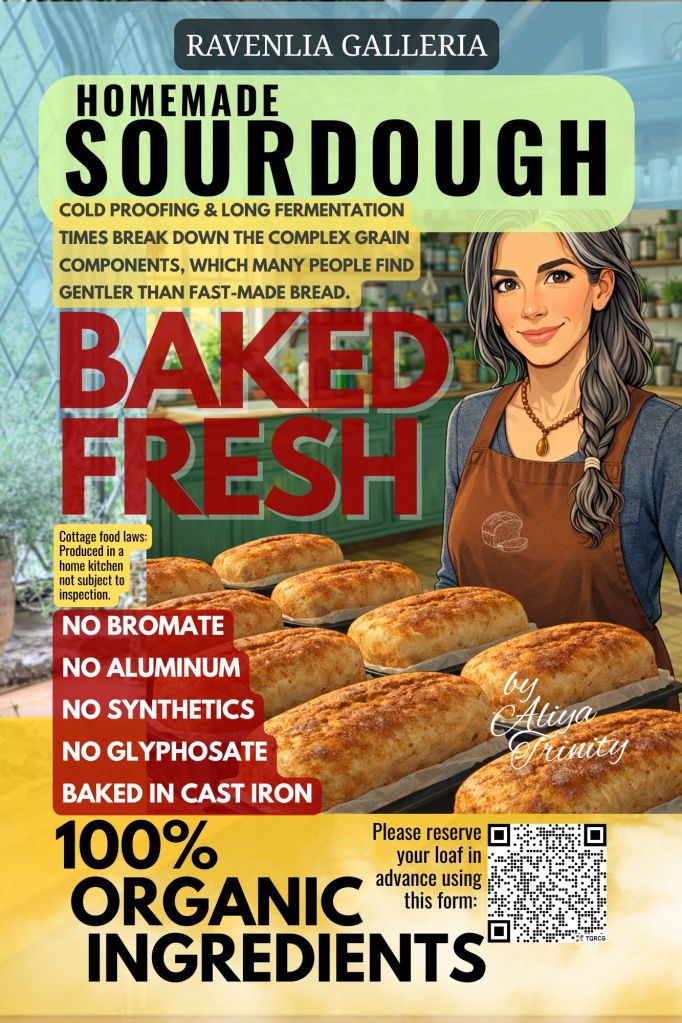
Created in the old-world tradition of our ancestors, my sourdough starter begins with wild yeast cultivated from fruit — slowly awakened, nurtured, and transformed into a living culture. From this culture, each loaf is born.
Baked in cast iron for deep heat, strong rise, and a naturally crisp crust. No synthetics, No dough conditioners, No bromated flour, No artificial enhancers. No artificial preservatives. No commercial yeast. No synthetic additives. Just real ingredients, long fermentation, and thoughtful baking.
True sourdough cannot be rushed. It asks for patience. It asks for rhythm. Each day carries its own temperature, its own humidity, its own invisible conditions — and so the dough must be read, not timed. It rises when it is ready.
Longer, colder fermentation develops a deeper, more complex flavor and allows the dough time to transform. Through this slow process, the bread becomes gentler on digestion and offers nourishment that feels completem satisfying in a way that quick breads rarely are.
No commercial yeast. No shortcuts. Natural ingredients and time — the way bread has been made for thousands of years. This is bread made with time, attention, and respect for the natural order of things. Alive before it is baked – it’s slow bread for a steady life.
I hope you enjoy it,
Aliya Trinity
What Makes This Bread Different
Naturally Fermented (Long-Rise Process)
Each loaf is naturally fermented through a slow, long-rise process, sometimes taking 1-2 days, allowing the wild cultures to do their work. This traditional method helps gently break down the flour, creating depth of flavor and a texture that feels satisfying rather than heavy.
Hand-Shaped & Baked in Cast Iron
Every loaf is shaped by hand and baked for a deeply caramelized crust and a soft, structured interior. The result is a rustic loaf with a golden exterior and an airy crumb. Using cast iron loaf pans and unbleached parchment paper means there are no aluminum or non-stick pans used in our baking. This thoughtful step keeps your bread safe, even while baking.
Flavor & Texture
Expect a balanced, slightly tangy flavor — never overpowering. The crust is firm and crisp when fresh, softening beautifully by the next day. The interior is tender, with natural air pockets created by fermentation rather than chemicals. It toasts beautifully. It holds up to butter and olive oil. It pairs well with soups, ferments, cheeses, and simple meals.
Why Traditional Fermentation Matters
True sourdough relies on wild yeast and beneficial bacteria naturally present in the starter. Over time, this slow fermentation transforms the dough. Many people find traditionally fermented bread feels different than quick-rise breads. The slow process creates complexity — in flavor and in structure. This is not fast bread. This is patient bread.
Storage & Care
The very best things for you don’t last very long, as there are no artificial preservatives. This bread is no exception. It is best enjoyed within a few days, and if you refrigerate it, it can last up to a week. Bread made through slow fermentation does not require special preservatives. It simply requires thoughtful storage and gentle reheating — the way bread has been cared for for generations.
- Store cut-side down on a wooden board or wrapped in breathable paper. Avoid sealing the loaf in plastic unless the goal is to soften the crust. If the kitchen is especially humid, keep it in a paper bag inside a bread box to allow airflow while protecting it from excess moisture.
- To crisp up a slice: Melt a dab of butter in a cast iron pan and place the sourdough slice onto the warm surface. Cook until lightly browned and crisp along the edges. Enjoy warm, topped with real butter, cream cheese, or simply as it is.
- To refresh the loaf: Lightly mist the crust with water and warm in a 350°F oven for 5–8 minutes. This reactivates the crust and restores the fresh-baked texture.
- For longer storage: Slice the loaf once fully cooled and freeze in a paper bag placed inside a freezer-safe container. Toast slices directly from frozen, or allow them to thaw at room temperature. Freezing preserves quality far better than refrigeration.
- Avoid refrigeration when possible. The refrigerator accelerates starch retrogradation, causing bread to stale more quickly.
- For peak flavor and texture, enjoy within the first two to three days — when the crust is lively and the crumb still supple from fermentation.
All Natural Ingredients:
🌾 Hard Red Wheat Organic Bread Flour
Organic hard red wheat bread flour forms the foundation of this loaf. It is unbleached, organically grown, and chosen for both strength and integrity. Hard red wheat is naturally higher in protein, allowing strong gluten development without added conditioners. Organic cultivation avoids the routine use of synthetic herbicides and chemical desiccants commonly applied in conventional grain farming. Recent independent testing in Florida drew attention to detectable glyphosate residues in several commercial bread products made with conventionally grown wheat. While regulatory agencies maintain that those levels fall within federal safety limits, the findings renewed public conversation about agricultural chemical residues in staple foods.
Choosing organic flour reflects a preference to minimize that exposure at the source. The goal is not alarm — it is intention. The gluten in this bread develops naturally through organic hard red wheat and slow fermentation, creating structure and elasticity without added vital wheat gluten or chemical dough conditioners.
In contrast, much conventional flour used in large-scale commercial bread production is derived from wheat grown with synthetic herbicides, and in some cases pre-harvest desiccants. Conventional flour may also be bleached for whiteness and enriched with synthetic vitamins after processing removes naturally occurring nutrients. Industrial baking systems often depend on this highly refined flour, then rebuild texture and structure through additives, conditioners, and enzyme systems. Organic, unbleached flour retains more of its natural character and does not require chemical whitening or synthetic enrichment to perform. The difference begins long before the dough is mixed — it begins in how the grain is grown and handled from field to mill.
🧫 Live Organic Sourdough Culture
This bread rises through a living sourdough culture of wild yeast and beneficial bacteria made in the old world way, from local fruit, and time. Unlike commercial yeast, which is cultivated as a single fast-acting strain, a true sourdough culture contains a diverse ecosystem of naturally occurring yeasts and lactic acid bacteria. These organisms work slowly, breaking down starches and proteins while producing organic acids that deepen flavor and strengthen structure. Long fermentation allows the dough to develop character, improves crumb texture, and supports a more balanced transformation of the grain. This culture is maintained, fed, and tended — not opened from a packet — and its vitality directly shapes the rise, aroma, and complexity of every loaf.
Although temperature and humidity play a large role here, our natural fermentation and rising method means it often takes 3 days to create a single loaf of bread.
In contrast, most commercial breads rely on isolated commercial baker’s yeast designed for speed, predictability, and high-volume production. Rapid-rise systems shorten fermentation to a matter of hours, often requiring added sugars, dough conditioners, and enzymes to compensate for lost development time. These loaves are engineered for uniformity and efficiency. A living sourdough culture functions differently — it depends on time, temperature, and balance. Rather than forcing expansion quickly, it cultivates it gradually, allowing the grain to transform naturally through fermentation rather than mechanical acceleration.
💧 Spring Water
Spring water plays a foundational role in fermentation. It hydrates the flour, activates gluten formation, and awakens the sourdough culture. Naturally mineralized, chlorine-free water supports the living yeast and beneficial bacteria responsible for rise and flavor development. In practice, fermentation simply does not perform the same in chlorinated water. The culture struggles, growth slows, and the dough lacks vitality.
Clean spring water allows the microbial ecosystem to function as intended, creating proper expansion, balanced acidity, and a well-developed crumb.
In contrast, municipal water is commonly treated with chlorine or chloramines to control microbial growth in public systems. While appropriate for sanitation, these disinfectants are designed specifically to inhibit bacteria — including the beneficial organisms that power sourdough fermentation. Even small residual amounts can interfere with rise and overall dough performance. Industrial bakeries often rely on commercial yeast and dough conditioners that are less sensitive to water quality, but naturally fermented bread depends on a living culture. Choosing chlorine-free water is not a cosmetic decision; it directly affects whether the bread can rise and mature properly.
🥣 Plain Organic Greek Yogurt
By adding organic Greek yogurt, a deeper layer of fermentation is introduced. It contributes natural lactic acid, additional live cultures, gentle richness, and improved moisture retention — all of which support a tender, resilient crumb. In a naturally leavened dough, the yogurt becomes nourishment for the living sourdough culture, strengthening the microbial balance and enhancing flavor complexity. Softness develops as a result of whole-food fermentation and traditional dairy cultures rather than external modification.
In contrast, many soft commercial breads achieve their texture through industrial emulsifiers and processing aids, such as DATEM, mono- and diglycerides, polysorbate 80, and sodium stearoyl lactylate (SSL), as well as added sweeteners like high-fructose corn syrup, dextrose, or malt syrup. These ingredients are designed to manipulate gluten structure, retain moisture, and extend shelf life in mass-production environments. While widely used in commercial baking, they are functional additives rather than traditional food ingredients. The preference here is for fermentation, time, and whole foods to create tenderness — not engineered softness.
🌻 Extra Virgin High-Oleic Organic Sunflower Oil
This unrefined high-oleic sunflower oil isn’t like the heavily refined industrial seed oils that are often discussed in health headlines. High-oleic refers to the fatty acid profile of the sunflower itself — it is naturally rich in oleic acid, a monounsaturated fat that is far more stable than standard polyunsaturated sunflower oil. Cold-pressed extraction avoids chemical solvents and high-heat deodorizing processes, preserving the oil’s natural structure and antioxidant components. Because of this stability, it resists oxidation more effectively and performs beautifully in baking. It softens the crumb, enhances elasticity, extends freshness, and naturally slows staling. This oil is organic, cold-pressed, and intentionally selected for both purity and oxidative stability.
In contrast: Many store-bought breads contain refined seed oils or blended vegetable oils that are extracted with solvents, exposed to high temperatures, bleached, and deodorized to create a neutral flavor and long shelf life. These highly processed oils are designed for mass production efficiency rather than minimal processing. The difference lies not only in the type of oil used but in how it is grown, extracted, and handled from seed to loaf.
🧂 Himalayan Pink Mineral Salt
Himalayan mineral salt is chosen for simplicity and balance. It is minimally processed and naturally harvested, retaining trace minerals that contribute subtle complexity to flavor. In bread, salt does far more than season — it regulates fermentation, strengthens gluten structure, and supports proper crumb development. Without salt, dough ferments too quickly and weakens; with it, structure and flavor come into harmony. Because it contains naturally occurring trace minerals alongside sodium chloride, many people appreciate it as a more balanced mineral source. These trace elements are often described as supporting the body’s ability to properly utilize sodium within a well-rounded diet. This mineral salt contains no added anti-caking agents, no chemical bleaching, and no synthetic iodine — simply dried, crushed crystal used intentionally for both function and minimal processing.
In contrast, conventional table salt is typically heavily refined to remove nearly all trace minerals, leaving primarily isolated sodium chloride. It is often bleached for whiteness and blended with anti-caking agents such as calcium silicate to prevent clumping, and commonly fortified with synthetic iodine. Some perspectives suggest that when sodium is consumed in highly refined, isolated form and in excess, the body must work harder to maintain mineral balance. However, mainstream nutrition science does not support the idea that standard table salt directly “pulls nutrients from organs or bones”, yet many studies have shown this is happening over time.
The main difference here lies in a preference for minimal processing and naturally occurring mineral complexity over industrial refinement.
🍎 Organic Apple Cider Vinegar
Organic apple cider vinegar is used in small, intentional amounts to support the natural balance of the dough. Traditionally fermented apple cider vinegar contains organic acids that gently reinforce gluten structure and contribute to crumb stability. In sourdough baking, balanced acidity helps regulate fermentation speed, enhance flavor depth, and support a tender yet structured interior. The presence of naturally occurring acetic acid can also contribute to a mildly protective environment that slows spoilage. When organic and traditionally crafted, apple cider vinegar reflects a simple fermentation process — apples transformed through time, without synthetic additives or artificial acidifiers.
In contrast, Many commercial breads rely on refined acids or chemical preservatives to extend shelf life and control mold growth. Ingredients such as calcium propionate or synthetic vinegar powders are commonly used to achieve uniform acidity and long storage stability in plastic packaging. These additives are designed for large-scale efficiency and prolonged distribution timelines.
Choosing organic apple cider vinegar reflects a preference for naturally fermented acidity over laboratory-formulated preservation systems, allowing structure and flavor to develop through traditional fermentation principles rather than chemical stabilization.
What Is Not Included
- No chemical dough conditioners
- No artificial flavors, colors or preservatives
- No bleached flour
- No emulsifiers designed to mimic softness
- No added sugars solely for rapid rise
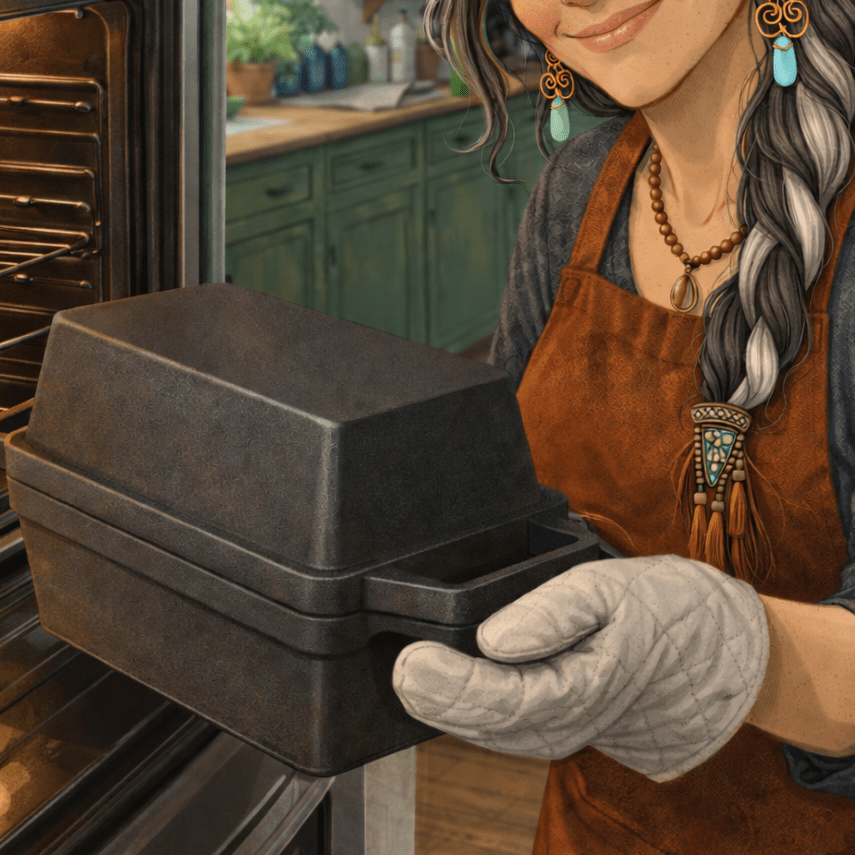
The Vessel Matters
Bread absorbs more than flavor. It absorbs its environment — heat, air, contact, storage. Here is why cast iron, unbleached parchment, and brown paper bags are chosen — and how that differs from common commercial tools.
Cast Iron Pans over all other pans
Cast iron holds and distributes heat evenly. Once hot, it stays hot. This creates a strong oven spring, well-developed crust, stable baking temperature, and deep caramelization. The thermal mass of cast iron mimics old masonry ovens. Heat surrounds the dough rather than shocking it unevenly. Cast iron offers durability, steady heat retention, and a naturally seasoned surface without synthetic coatings — making it a grounded, traditional choice for baking rather than lightweight aluminum alternatives. Cast iron is a simple metal — seasoned and durable — without synthetic surface coatings.
In contrast:
- Non-stick pans often rely on synthetic coatings (such as PTFE-based finishes), can degrade at high temperatures, do not hold heat as evenly, produce thinner crust development, are contributing to Forever chemicals in our environment and bodies.
- Aluminum pans heat quickly but also lose heat quickly, can cause uneven browning, are lightweight, and less thermally stable. But mostly, I avoid them as elevated levels in the body have been associated with neurological and long-term health concerns in some research. While aluminum cookware is widely used and considered acceptable within regulatory standards, minimizing unnecessary exposure is a simple precaution.
Unbleached parchment over Silicone Pan Liners.
Unbleached parchment is paper that has been treated for heat resistance without chlorine bleaching. It is single-use and breathable, and it avoids chlorine processing used in bleached white parchment. It contains minimal additives beyond the parchment treatment itself and it does not contain synthetic polymer coatings in the way silicone does. Parchment paper does not create a reusable polymer surface; it is essentially treated cellulose designed for heat resistance and clean release. The choice here favors minimal processing.
In contrast, with heavy wear, scratching, or aging, silicon pan liners can flake or shed small particles. While current research suggests that small amounts of ingested inert polymer particles pass through the body without significant absorption, long-term data on cumulative microplastic exposure is showing different results. Additionally, synthetic liners are environmentally persistent. Many synthetic polymer coatings do not break down easily in the environment. The impacts of disposal and manufacturing are often part of the broader discussion of minimizing synthetic materials in food preparation.
Paper Bags vs Plastic Bags
Brown paper bags support the natural rhythm of real bread. Freshly baked sourdough continues to release moisture as it cools, and paper allows that excess humidity to escape while still protecting the loaf. This helps preserve crust texture, prevent condensation, and maintain balance between interior softness and exterior structure. Paper is breathable, simple, and plant-based — aligning with traditional bakery practices that respect the living quality of fermented bread rather than sealing it away.
In contrast, plastic bags trap moisture, creating a humid environment around the loaf. While this can keep bread feeling soft longer, it also softens the crust quickly and may encourage condensation and mold inside the packaging. Plastic is non-breathable and petroleum-based, designed for maximum shelf stability and transport efficiency.
Choosing paper over plastic reflects a preference for airflow, material simplicity, and environmental responsibility — allowing bread to remain bread, not compressed into uniform softness for storage convenience.
The Difference
This bread represents a deliberate standard — shaped by organic grain, living fermentation, mineral balance, clean water, and carefully chosen materials. While many commercial loaves prioritize speed, uniformity, and extended shelf stability, this sourdough develops through time, structure, and natural transformation. Its strength comes from protein-rich wheat, its softness from whole-food fats and cultures, and its preservation from balanced acidity rather than synthetic additives. The result is a loaf formed by patience rather than production — bread that reflects integrity, nourishment, and a commitment to living well from field to oven.
COTTAGE FOOD LAWS: produced in a home kitchen not subject to inspection. Baked by Aliya Trinity, Galax, VA 24333.
 RAVENLIA GALLERIA